
Some prayers don’t come out right when you say them aloud. They come out better on paper, slowly, one honest sentence at a time.
Writing a letter to God is one of the oldest and simplest ways to pray. You don’t need special words or a perfect faith. You need a pen, a few quiet minutes, and the willingness to say what’s really on your heart.
Below is a simple way to begin, plus 30 prompts for different seasons of life.
Why write your prayers as letters?
Much of the Bible’s prayer was written down. The Psalms are full of it: praise, thanks, complaint, confusion and hope, often all in the same psalm. Psalm 13 begins “How long, O Lord?” and ends with “I trust in your unfailing love.” Writing gives you room to travel that same distance.
- It slows you down. Your mind wanders less when your hand has to keep up.
- It lets you be honest. Many people find they can write what they can’t yet say out loud.
- It keeps a record. Months later, you can look back and see prayers you’ve forgotten, and sometimes how they were answered.
- It works in every season. Grief, doubt, gratitude and waiting all fit on a page.
How to write a letter to God in 5 steps
- Find a quiet place and a notebook you keep for this. A dedicated notebook makes it easier to come back, and to look back.
- Start with “Dear God” and the date. Dating each letter is what turns a habit into a story you can read later.
- Write what’s true, not what sounds right. If you’re angry, say so. If you’re grateful, say why. God isn’t grading your grammar.
- Bring Scripture in if it helps. Copy a verse that speaks to where you are, or write a psalm in your own words.
- End with what you hope for. A request, a thank you, or simply “I’m still here.” Then close the notebook and let it rest.
30 prompts for letters to God
When you’re grieving
- Today I miss them most when…
- Here is what I wish I had said.
- I don’t understand why this happened. Here is my question.
- Something small that comforted me this week was…
- I’m afraid that if I stop grieving, I’ll forget…
- Help me carry this today. Here’s what “today” looks like.
When you’re doubting
- The question I’ve been afraid to ask you is…
- I used to believe ___. Now I’m not sure because…
- Where were you when…?
- If you’re listening, here is what I need you to know.
- A time I felt close to you was…
- What would it look like to trust you a little today?
When you’re grateful
- Three ordinary things I’m thankful for today are…
- A person you put in my life at just the right moment was…
- Something I prayed for that you answered was…
- A beautiful thing I noticed this week was…
- Thank you for the way you…
- Here is a blessing I almost missed.
When you’re waiting
- I’ve been waiting for ___ for ___. Here’s how it feels.
- What I want most right now is…
- Help me to be faithful in the meantime by…
- If the answer is “not yet,” help me to…
- Someone else who is waiting, whom I want to pray for, is…
- Here’s what I can still do while I wait.
When you’re coming home
- It’s been a long time since I wrote to you. Here’s why.
- The thing that pulled me away was…
- What I’d like to say sorry for is…
- What I’ve missed about you is…
- Here is one step back toward you I can take this week.
- If I could start again, I’d like it to look like…
A grandmother’s letters
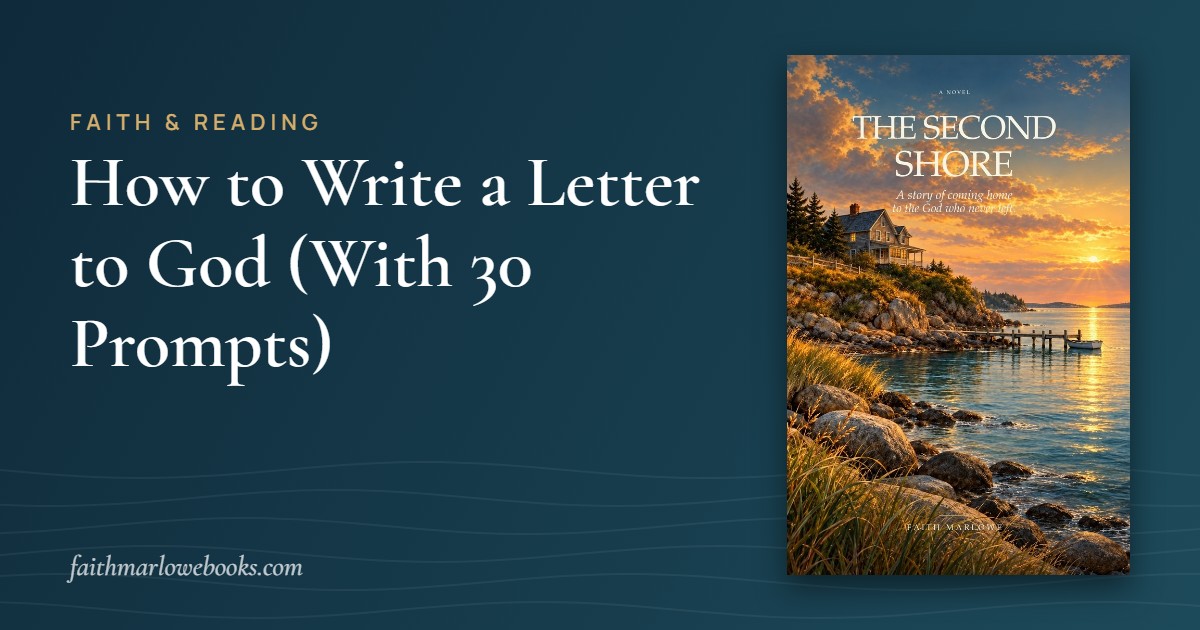
In Faith Marlowe’s novel The Second Shore, Nell Calloway clears out her late grandmother’s house and finds more than sixty years of letters Ruth wrote to God. Ruth’s first letter begins:
“Dear God, I don’t know if you keep letters. I like to think you do…”
Ruth’s letters aren’t polished. They hold the questions Nell thought faithful people were never supposed to ask, and they show a faith that kept writing anyway. If you’ve ever wondered whether your own letters are “good enough,” Ruth’s are a gentle answer.
Read an excerpt from The Second Shore
Frequently asked questions
Is writing a letter to God a real form of prayer?
Yes. Prayer is talking with God, and many Christians across traditions pray in writing. Prayer journals, written psalms and letters are all ways of bringing your heart to God.
What should I do with my letters after I write them?
Many people keep them in a notebook or a box, as Ruth does in The Second Shore. Rereading them later can show you how God has been at work. Some people prefer to write and then let the letter go. There’s no wrong way.
Can I write to God when I’m angry or doubting?
Yes. The Psalms include anger, confusion and complaint, and Job argued with God at length. Honest letters are often where faith starts to grow again.
How often should I write?
As often as it helps. Some people write daily, others weekly or only when something weighs on them. Consistency matters more than length.
Start your first letter today
Pick one prompt above, set a timer for ten minutes, and write. That’s all it takes to begin.
Want to go deeper? The free Scripture Companion for The Second Shore explores the psalms and passages behind Ruth’s letters.